This news piece reports on the event ‘From Test to Field: Connecting AI, Robotics and Digital Services for Agri-Food SMEs’, held on 15 April 2026 [Watch the recording]. It marked the first in a series of thematic events designed to spotlight the ecosystem of services delivered by Digital Europe Programme projects and to make these offerings more visible and accessible to end users in specific markets and vertical sectors. Further sessions will follow to explore additional domains and service pathways. Stay tuned for the next event announcement.
Europe’s agri-food sector is entering a new phase of digital transformation. Artificial intelligence, robotics and data-driven technologies are becoming increasingly available tools, supported by significant public investment. Yet the transition from innovation to everyday use remains uneven, and often slow.
This challenge was at the centre of the online event “From Test to Field: Connecting AI, Robotics and Digital Services for Agri-Food SMEs”, which brought together participants from across Europe, including EU-funded Digital Europe projects, SMEs, researchers and agri-food organisations. The event was organised by DEDEP.eu, CoordinaTEF and DTA Phase II supporting the network of European Digital Innovation Hubs (EDIHs). The objective was not simply to present technologies, but to better understand how they can move beyond experimentation and deliver real value in practice.
The discussion highlighted a key paradox. Europe has built a comprehensive ecosystem to support digital innovation, with initiatives ranging from Testing and Experimentation Facilities (TEFs) and EDIHs to data spaces and advanced digital skills programmes. However, for many end users, this ecosystem remains difficult to navigate.
As Gaspard Demur (Deputy Head of Unit, AI Innovation and Policy Coordination - EU AI Office at the European Commission) pointed out:
“What is the client journey for a company? Once you enter this ecosystem, how can you be guided to the right points, depending on your needs?”
The issue is no longer the availability of tools, but the lack of a clear and accessible pathway to use them.
For SMEs and farmers, the starting point is rarely technology itself. Their priorities are more immediate: reducing costs, improving efficiency, and managing risks. When digital solutions are presented without a clear link to these needs, adoption becomes difficult.
This gap was clearly articulated by Raffaele Bini (DATAlife):
“Businesses do not ask for artificial intelligence or data spaces. They ask to reduce costs, improve competitiveness, and efficiency. And it is necessary to translate those needs into the right services...”
At the same time, structural challenges continue to limit uptake. Alessio Bolognesi (FederUnacoma) noted that
“The lack of business models for agricultural robotics or AI-based solutions is still a problem, because it is mostly a matter of cost for the farmers to access those technologies.”
These constraints are particularly visible in regions dominated by small-scale operations. Juho Pirttilahti (Seinäjoki University of Applied Sciences) highlighted that in regions like South Ostrobothnia, as in most of Finland:
“95% of these are micro-enterprises. [For them] investments are really hard to make.”
Speakers also pointed out a recurring issue in the innovation pipeline. Many promising AI and robotics solutions remain at the “proof of concept” stage, never fully reaching the market.
As Bini further observed:
“A lot of technological solutions that can help on the field don’t reach the field.”
Bridging this gap requires a shift in approach: from developing technology for its own sake to designing solutions that directly respond to user needs and operational realities.
Here, the relationship between TEFs and EDIHs emerged as a critical link. While TEFs provide advanced environments to test and validate technologies under real conditions, EDIHs act as local entry points, supporting organisations in experimenting with and adopting these solutions through “test before invest” services.
As Hazel Peavoy (Walton Institute / ENTIRE EDIH) explained:
“The European Digital Innovation Hubs are about using the technologies that are readily available [...] to ensure that they fail fast [...], so that if the concept doesn’t come to fruition, they haven’t spent too much…”
At the same time, demonstrating real impact remains essential to build trust. Raffaele Giaffreda (agrifoodTEF) emphasised that
“If you are testing a technology, you are providing evidence of what technology can bring to the bottom line of a farm [...], then you are engaging with them on a sales pitch which is much more convincing.”
Beyond infrastructure, trust and skills were also identified as essential factors for adoption. The ability to demonstrate concrete benefits (such as time savings, cost reductions or improved yields) is key to convincing users. At the same time, concerns around data sharing, interoperability and data sovereignty continue to influence adoption decisions.
Jurgen Vangeyte (ILVO / CEADS) highlighted the strategic importance of data governance, warning that
“a lot of our data is taken by others… and sold back to us,”
and stressing that data spaces can play a key role in addressing this imbalance.
At the same time, farmers do not necessarily need to step in the data space, they are users of the data space:
“Initially, we had some hard time convincing them because they thought we were going to misuse their data. But when we explained how the data space can reduce the administrative burden, we convinced many farmers”.
Thus, practical incentives remain crucial:
“With a data space, you just give in the data only once, and then you are off the paperwork… that is something that worked really well.”
Equally important is the skill dimension. The sector increasingly requires professionals who can bridge the gap between agriculture and digital technologies.
As Paola Scarpellini (University of Pisa / Agritech EU) noted:
“The challenge is to train specialists who can combine farmers' needs with the new technologies.”
The second part of the event shifted from discussion to action. In a closed workshop, representatives from DIGITAL-funded projects worked together to reflect on shared challenges and explore opportunities for closer collaboration. Rather than focusing on individual initiatives, the exercise encouraged participants to take a broader view of the ecosystem, identifying where services overlap, where gaps remain, and how better alignment could support uptake.
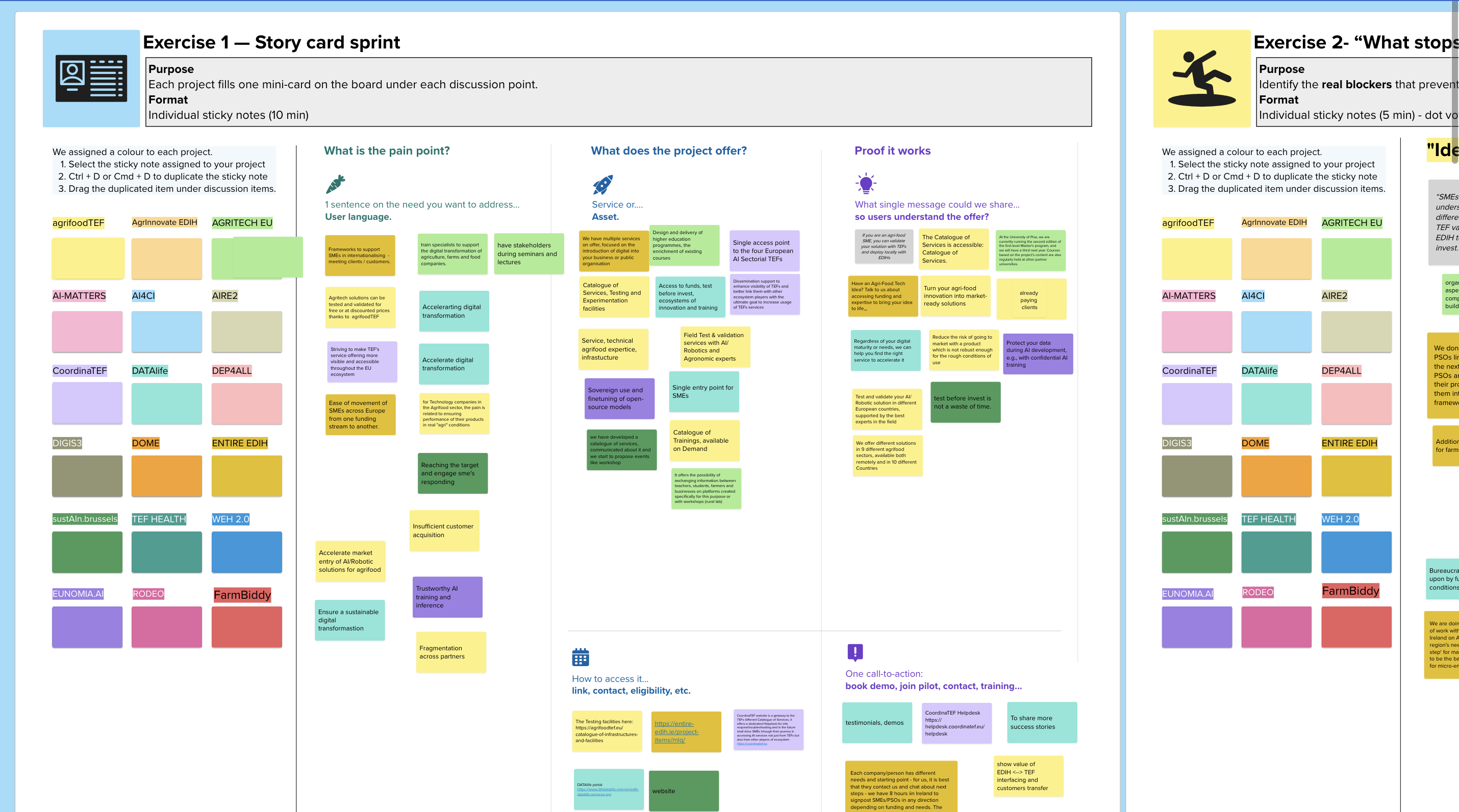
A strong sense of complementarity emerged, alongside a recognition that more coordination is needed. As one participant, Lucía Castro Diaz (DATAlife), reflected:
“The most important result is that we are actually collaborating, bringing together different training initiatives into a more coordinated, shared programme.”
The conclusion of the event was both pragmatic and forward-looking. Europe has already invested heavily in building the foundations of digital innovation in agri-food. The next step is ensuring that these foundations translate into real impact.
Innovation, as several speakers implicitly underlined, only creates value when it is adopted. Making that adoption easier, by connecting services, aligning efforts, and focusing on user needs, will be key to ensuring that Europe’s digital ambitions reach the field.