Connecting Europe's digital health ecosystem
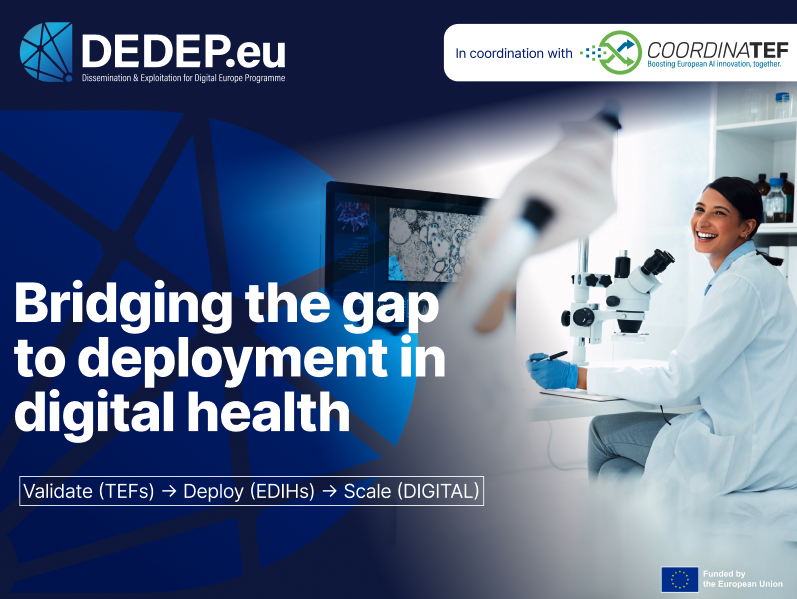
Testing facilities, innovation hubs, hospitals and data infrastructures shared practical pathways to help health AI innovators reach the market, at a joint DEDEP.eu and CoordinaTEF webinar.
Europe does not lack ideas in digital health. The real challenge is deployment. That was the starting point for the second webinar in a series co-organised by DEDEP.eu, which promotes synergies in dissemination and exploitation across Digital Europe Programme projects, and CoordinaTEF, the coordination and support action for the Testing and Experimentation Facilities (TEFs). After a first edition on agrifood, this session turned to health, a sector being reshaped by artificial intelligence and robotics.
The event drew more than 160 registrations, 51% of them women, and over 30 EU-funded projects. A public panel was followed by an interactive workshop for project representatives, designed to turn the panel's ideas into concrete collaboration points.
Opening the session, Jaakko Aarnio, Policy Officer in the AI Innovation and Policy Coordination unit at DG CONNECT, set the tone. Around 40 European Digital Innovation Hubs (EDIHs) take part in the working group on digital health, acting as knowledge and business brokers for SMEs. SMEs, he stressed, want knowledge and services quickly and are not concerned with which programme they come from. Bridging funded initiatives, and reaching beyond grant boundaries to the organisations behind them, is therefore essential. He pointed to promising examples such as the collaboration between TEF-Health and EDIHs in Sweden and Portugal, and emerging links between EUCAIM, the European Cancer Imaging Initiative and TEF-Health.
Five perspectives on the path to market
TEF-Health: a single entry point for validation. Petra Ritter, Professor of Brain Simulation at Charité – Universitätsmedizin Berlin and coordinator of TEF-Health, explained how TEFs, as defined in the EU AI Act, give scientific and technical support to companies and notified bodies. TEF-Health brings together around 50 public and private organisations and focuses on technical and clinical validation, real-world evaluation and regulatory compliance. Its matchmaking platform offers a public service catalogue, with prices, and runs open calls for subsidised or free services. A front office of real people then matches each company with the right providers and health data sources, often across borders.
EDIHs: local reach, shared purpose. Sebastiaan Meijer, Professor of Healthcare Logistics at KTH Royal Institute of Technology and chair of the EDIH working group on digital health, represents Health Data Sweden. EDIHs each have their own grant and local context, and that bottom-up diversity is their strength. All offer ecosystem, business and financing, skills and test-before-invest services. The question, he argued, is not what TEF-Health or the EDIHs offer, but what a company needs across a life cycle that repeats many times.
The Hospital Innovation Challenge. Priscila Maranhão, Project Manager at Health Cluster Portugal, presented a challenge run with TEF-Health and the DigiHealth PT EDIH that puts hospitals' real needs in front of innovative SMEs. The first edition involved five TEF-Health hospitals and attracted 23 applications from 10 countries. The three winners are now running studies within TEF-Health. Feedback reshaped the second edition: an online first evaluation, EDIH support for non-selected companies, and an external jury of investors, clinicians and public bodies. The call is now open to all Portuguese hospitals, public and private.
From advanced prototype to certified device. Tiago Carvalho, Project Manager and Clinical Research Assistant at Instituto Pedro Nunes (IPN), showed how IPN HealthProof supports start-ups from design to regulatory approval. CardioAI, a cloud-based ECG analysis platform, was already clinically mature but faced MDR and ISO 13485 gaps. With TEF-Health support, IPN updated its technical documentation and resolved audit findings. CardioAI is now a CE-marked Class IIa medical device with a certified quality management system.
EUCAIM: federated cancer imaging data. Ignacio Blanquer, Professor at the Universitat Politècnica de València and technical coordinator of EUCAIM, described a federated infrastructure aligned with the European Health Data Space. Users find data through a central catalogue and federated search, request access through a negotiator tool, and work in secure processing environments without data leaving its source. EUCAIM aims to become a European Digital Infrastructure Consortium (EDIC) hosted by Spain, with 18 countries interested, and is preparing a joint challenge with TEF-Health.
Panel discussion: evidence, markets and synergies
The discussion turned the presentations into lessons for the wider ecosystem. Petra Ritter gave a second example: TEF-Health helped Sonovum, which measures brain pressure non-invasively with AI, move from TRL 6 to TRL 8. Neurosurgeons tested the device in a clinical setting, fed back to refine the algorithm and helped clarify the regulatory pathway. The product is now in a registered clinical trial. More success stories from all four TEFs are on the CoordinaTEF website.
Sebastiaan Meijer stressed that the public sector is involved from A to Z, since healthcare is paid for by insurance or taxes. Markets must be prepared in parallel with validation, or even successful pilots will not scale. A recurring question is what local evidence is needed to adopt a solution proven elsewhere; Sweden alone has 21 regions and many local interpretations. Above all, "there should be no wrong entry" into the network: every request should be guided to the right place, even when no grant agreement requires it. That, he said, should be in the DNA of every Digital Europe structure.
Priscila Maranhão highlighted the value of direct conversations between SMEs and hospitals, which help identify which department can use a solution and open the door to testing. Tiago Carvalho added that leads arrive from many channels and that the TEF-Health platform helps route each company to the right partner, whether its need is regulatory, real-world testing or algorithm validation.
On scaling the EUCAIM–TEF-Health model, Petra Ritter noted that EUCAIM data services are already discoverable in the TEF-Health catalogue. Free or subsidised services fall under EU state aid rules, and TEF-Health's workflows for open calls, eligibility checks and reporting can be shared with other providers, such as national health data access bodies. Ignacio Blanquer added that pooling expertise in federated data and in regulatory validation creates a win-win model that other communities, such as cardiology, could follow.
Asked how they would define success, the panellists answered briefly:
- Petra Ritter: AI regulatory preparedness by design, as with GDPR by design.
- Sebastiaan Meijer: AI companies see the EU as a fertile place to test and deploy first, without going to the US.
- Priscila Maranhão: more hospitals involved, with more responsibility for validation.
- Tiago Carvalho: SMEs should come with a real gap, not a wish list, and build their regulatory roadmap block by block.
- Ignacio Blanquer: lower the complexity and cost of data access for SMEs.
From discussion to collaboration
In the interactive workshop, led by Gabriele Quattrocchi of DEDEP.eu, Digital Europe projects mapped their users' needs and barriers, the services they offer and how they reach adopters. They then identified quick-win collaborations across specific objectives, such as joint events and webinars between EDIHs, cybersecurity projects and AI Factories. Finally, they proposed policy recommendations. Recurring themes included:
- simple, clear language about benefits, and AI demystified through use cases
- a single, human contact point that guides SMEs and signposts them to TEFs, AI Factories and other programmes
- clustering activities and closer use of National Contact Points
- incentives such as micro-vouchers so SMEs can try services
The insights will feed into DEDEP.eu's analysis and recommendations on dissemination, exploitation and cross-project collaboration in the Digital Europe Programme. The event was supported by the EDIH Network. As the panel concluded, lowering complexity, increasing visibility and preparing for AI regulation by design are shared goals, and building bridges beyond grant boundaries should be part of the DNA of every Digital Europe initiative.
The recording and presentations from the public session will be available on the DEDEP.eu and CoordinaTEF websites.